


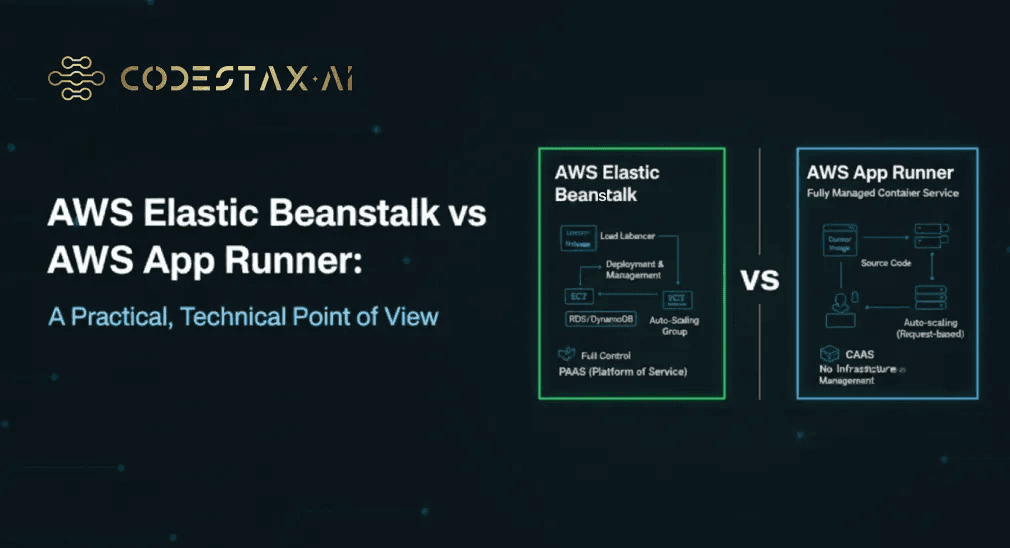
AWS Elastic Beanstalk vs AWS App Runner: A Practical, Technical Point of View
Cloud deployment today is less about simply “pushing code” and more about deciding how much infrastructure you want to manage, how deeply you need to customize, and what operational trade-offs you’re willing to accept. AWS Elastic Beanstalk and AWS App Runner both sit in the managed application deployment space, but they serve two very different philosophies: hands-on control with automation versus fully abstracted, serverless simplicity.
AWS Elastic Beanstalk: Managed Infrastructure You Can Still Touch
So — What Exactly Is Elastic Beanstalk?
Elastic Beanstalk comes from the early era of “let AWS automate, but don’t take anything away from me.” When you deploy an application, it automatically provisions everything you’d expect in a traditional cloud architecture: EC2 instances, security groups, load balancers, VPC networking, auto scaling, and more. All you do is upload your application package — whether that’s a Docker image, a classic ZIP deployment, or something else — and Beanstalk stands up the environment.
If you want to SSH into a machine, adjust the OS, install a custom agent, or launch with a specific AMI, Beanstalk lets you. It’s managed — but not abstracted.
And here’s the defining trait:
Nothing is hidden from you.
Supported platforms include:
Java, Python, Node.js, Ruby, Go, .NET, and PHP
Docker (including multi-container setups)
What stands out:
You see and control the infrastructure that runs your app
OS-level debugging and customization are fully available
Works well for both containerized workloads and older VM-centric applications
Integrates natively with AWS services like RDS, ElastiCache, and private VPC layouts
Where it can feel heavy:
Deployments are slower — provisioning EC2-based scaling can take minutes
Auto scaling requires tuning
You’re paying for the underlying infrastructure whether traffic is high or nonexistent
AWS App Runner: Serverless Deployment With Almost No Ops
What Is App Runner Designed For?
App Runner aims to deliver a Heroku-like experience for AWS: you give it a container or connect a Git repository, and AWS handles everything else. It builds the image, deploys it, scales it, and automatically exposes a secure HTTPS endpoint.
It’s powered behind the scenes by AWS Fargate — but you never interact with the servers, networking primitives, or container orchestration layers directly.
The platform’s core promise is simple:
Developers shouldn’t have to think about machines.
No SSH.
No instance tuning.
No networking complexity unless you explicitly opt in.
How deployments work:
Pull code from GitHub/Bitbucket or use a pre-built ECR container
App Runner builds and deploys automatically
Each running instance is isolated in an AWS-managed environment
Where it shines:
Almost zero operational overhead — push code and move on
Fast, concurrency-based scaling (instead of CPU-based instance scaling)
Warm instance pools significantly reduce or eliminate cold starts
Built-in CI/CD integration feels modern and effortless
Where the trade-offs show up:
Limited ability to customize the runtime or host environment
Best suited only for stateless HTTP workloads
Costs can scale quickly for sustained or heavy traffic
Technical Comparison Matrix
Deep Technical Breakdown
Deployment and Day-to-Day Experience
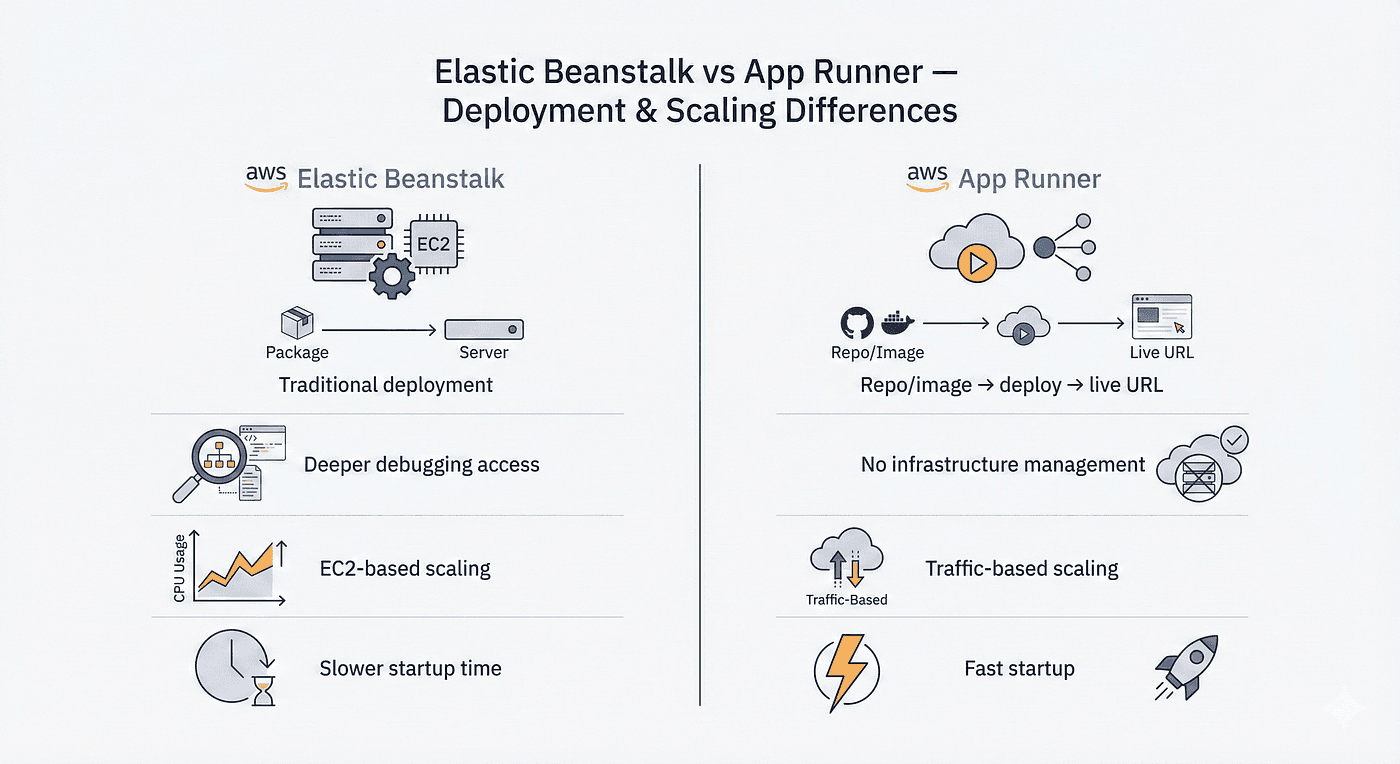
Elastic Beanstalk
Requires some familiarity with AWS environments and runtime configuration
Deployments feel traditional — package code, configure, deploy
Ideal when debugging needs deep inspection
Works well in migration scenarios where the application expects a full OS environment
App Runner
Very simple: repo or image → deploy → live URL
No need to understand instances, scaling groups, or networking paths
Logs and telemetry come through CloudWatch — not via direct system access
Perfect for microservices or development teams optimizing for fast iteration
Scaling Behavior
Elastic Beanstalk
Relies on scaling EC2 instances
Scaling decisions generally come from CPU or latency metrics
Startup times can take a while, so teams often overprovision
App Runner
Designed for traffic-responsive scaling
Simply set concurrency limits per instance; platform does the rest
Startup times are fast, avoiding the “burst traffic lag” seen in EC2 scaling
Networking and Security
Elastic Beanstalk
Integrates into private subnets without extra configuration
Perfect for services that need internal access to databases or secure networks
App Runner
Public-first design
Private networking is possible — but requires explicit VPC Connectors
Great for public APIs, less ideal for strictly internal workloads unless architected carefully
Cost Reality Check
Elastic Beanstalk
Costs accumulate whether the application is active or idle
Great for predictable, steady traffic
Reserved instances or savings plans can significantly optimize spend
App Runner
Pay only for compute and memory used
Ideal for unpredictable or intermittent workloads
Can become more expensive than EC2-based setups at large scale or constant load
CI/CD and Automation
Elastic Beanstalk
Flexible, but setup requires deliberate configuration
Supports advanced deployment patterns like blue/green or rolling upgrades
App Runner
CI/CD is built directly into the workflow — commit equals deployment
Rollbacks are automated and handled by the platform
Which One Should You Use?
Elastic Beanstalk is a strong choice if:
Your application requires OS-level tweaks or dependencies
You rely on inbound private networking or non-public endpoints
You’re migrating existing workloads that weren’t built for container-native environments
You need deep control for compliance, observability, or tuning
App Runner is ideal if:
Your workloads are stateless and HTTP-based
You want a fully managed experience with minimal configuration
Your traffic patterns are unpredictable or spiky
You’re already working in a container-first development model
Conclusion
There’s no universal winner here. Elastic Beanstalk offers flexibility and control when you still need to shape the environment. App Runner delivers the simplicity and “hands-off” development flow modern cloud teams crave.
Most organizations will land somewhere in the middle — using App Runner for fast-moving containerized services and Elastic Beanstalk for workloads that still require deeper control or legacy compatibility.
In the end, the right choice comes down to what your application needs today — and what flexibility you expect tomorrow. If speed and automation matter most, App Runner fits beautifully. If customization and visibility are non-negotiable, Beanstalk remains a solid and relevant option.