




Why Multi-Agent AI Is the Next Step for Businesses
Artificial Intelligence has become part of everyday business operations.
Companies use AI to create content, analyse data, answer customer queries, generate reports, and support decision-making. Most of these solutions rely on a single AI model that receives a prompt and generates a response.
For simple tasks, this works well.
But as business problems become more complex, a single AI agent starts to show its limitations.
Imagine asking an AI to build a complete marketing campaign, develop a business strategy, or optimise an operational workflow. While it may produce something reasonable, important questions often go unasked:
Has it reviewed its own work?
Has it validated its recommendations?
Has it considered different perspectives?
Has it learned from previous decisions?
In most cases, the answer is no. That is because the AI is working alone.
The Challenge with Single-Agent AI
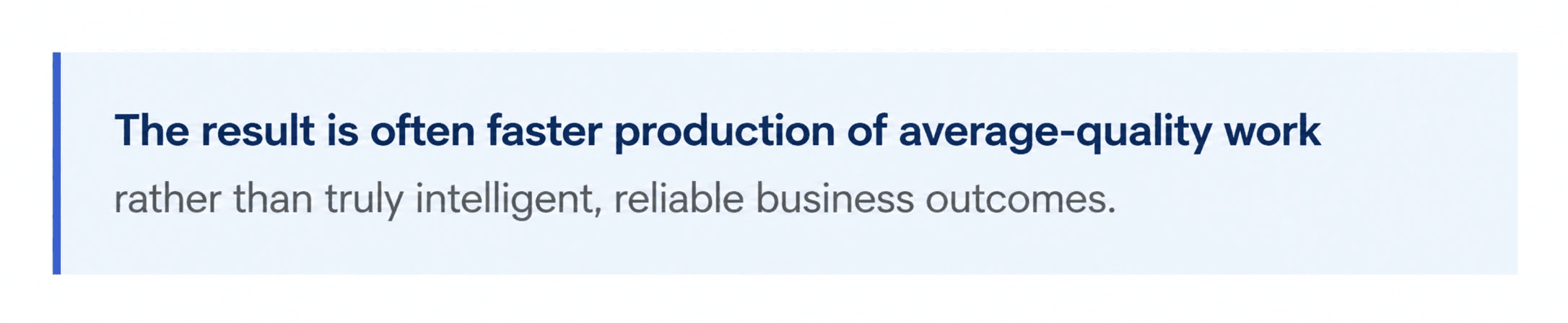
Most AI tools today operate on a single-agent approach. One model receives instructions, processes information, and delivers an output.
While powerful, this creates real limitations when dealing with complex business tasks.
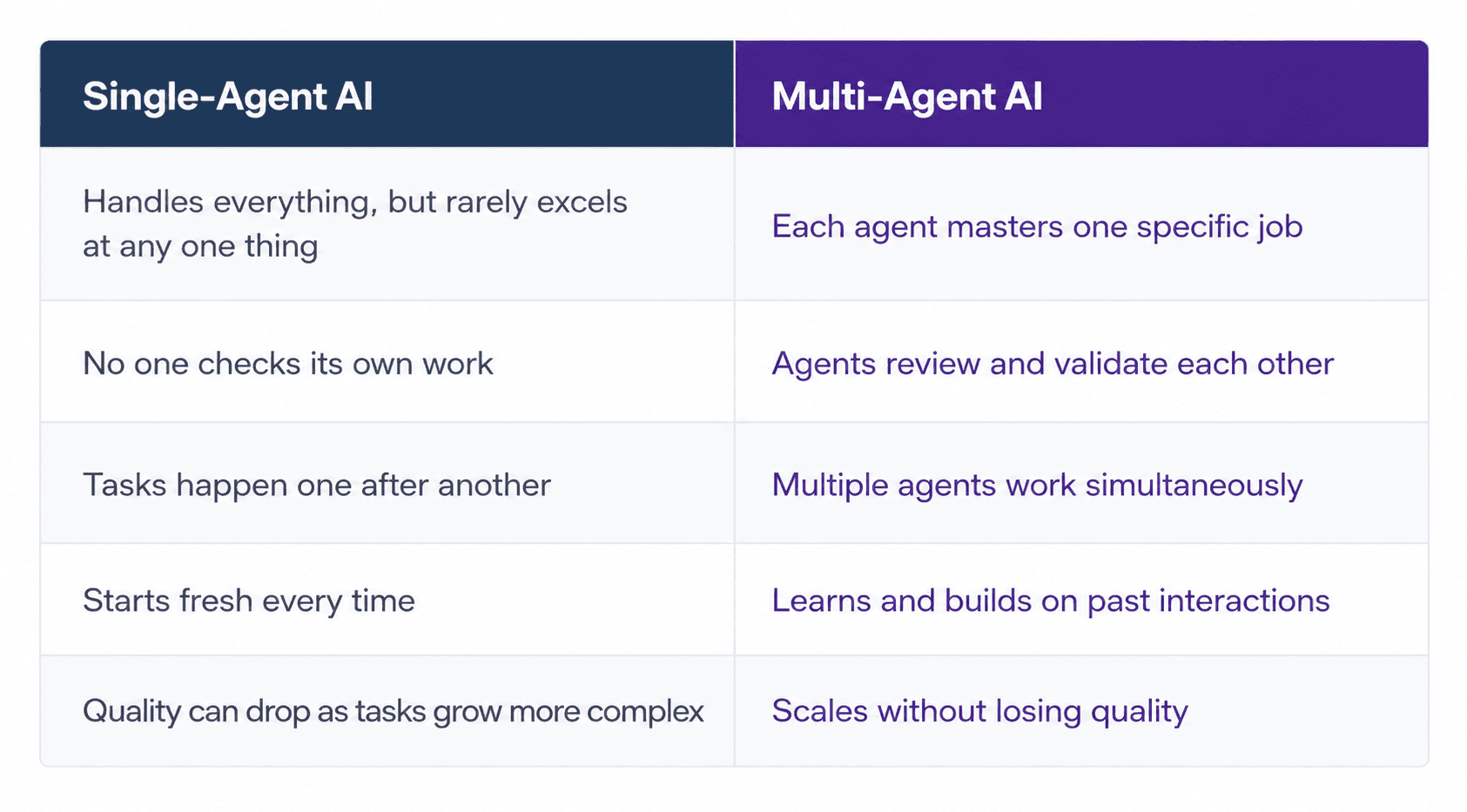
Limited Specialisation
A single AI is expected to act as a researcher, strategist, analyst, planner, reviewer, and executor all at once. It may perform reasonably across these areas, but it is rarely an expert in all of them.
No Internal Validation
The output is delivered directly to the user with no independent review. Mistakes, inconsistencies, or gaps can easily go unnoticed.
Difficulty Handling Complexity
As tasks grow larger and require more context, maintaining quality and consistency becomes increasingly difficult.
No Business Memory
Many AI systems start every interaction from scratch. They do not retain knowledge of previous decisions, customer preferences, or organisational goals.
A Better Approach: Multi-Agent AI
Instead of relying on one AI to do everything, organisations are now exploring Multi-Agent AI systems.
A Multi-Agent AI system is made up of multiple specialised AI agents, each responsible for a specific task, working together toward a shared goal.
This closely mirrors how successful organisations already operate. Different specialists contribute their expertise, review each other's work, and combine their efforts to achieve better outcomes. The same principle applies to AI
How a Multi-Agent System Works
At its core, a Multi-Agent AI system functions like a well-coordinated team. Here is how the workflow typically looks:
Step 1 — Understand the Requirement
The system receives a business problem or objective. An orchestration layer analyses it and decides which agents need to be involved.
Step 2 — Break Down the Work
The task is divided into components. Research, planning, analysis, content creation, validation, and reporting are each assigned to a specialised agent.
Step 3 — Work in Parallel
Multiple agents work simultaneously. While one researches, another analyses data and another develops recommendations. This saves significant time.
Step 4 — Share Information Continuously
Agents exchange outputs throughout the process. What one agent produces can directly influence and improve the work of another.
Step 5 — Review and Validate
Dedicated review agents check outputs for errors, inconsistencies, and opportunities to improve, before anything reaches the user.
Step 6 — Keep Humans in Control
Critical decisions can still be reviewed and approved by people. Multi-Agent AI supports better decision-making rather than replacing the human behind it.
Step 7 — Learn and Improve
Advanced systems store business knowledge, past decisions, and feedback. Over time, the system becomes more aligned with your organisation and continuously improves.
Real-World Examples
Multi-Agent AI is not a distant concept. It is already being applied to real business problems. Here are two concrete examples.
Example 1: E-Commerce Customer Support at Scale
A large e-commerce company receives thousands of customer queries every day: order status, returns, complaints, product questions, refund requests.
With a single-agent AI, one model tries to handle all of this. It frequently misclassifies queries, gives generic responses, and escalates too much to human agents.
With a Multi-Agent system:
A Classification Agent reads each incoming message and routes it to the right specialist agent.
A Returns Agent handles return and refund queries using live order data.
A Complaints Agent detects sentiment, prioritises upset customers, and drafts empathetic responses.
A Product Agent answers questions using the product catalogue and FAQs.
A Review Agent checks every response before it is sent, ensuring accuracy and tone.

Example 2: Patient Coordination in Healthcare
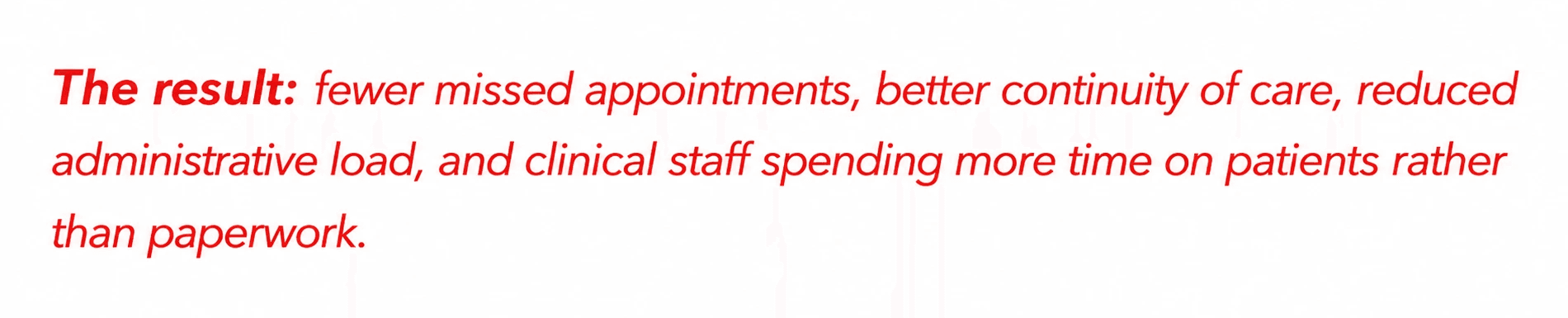
A hospital network struggles with fragmented patient communication. Appointment reminders are missed, follow-up care falls through the gaps, and administrative staff are overwhelmed.
With a Multi-Agent system:
A Triage Agent reviews incoming patient requests and determines urgency.
An Appointments Agent checks availability and books or reschedules as needed.
A Documentation Agent prepares pre-visit summaries and post-visit notes automatically.
A Follow-Up Agent sends timely reminders, care instructions, and check-in messages.
A Compliance Agent reviews all communications to ensure they meet regulatory standards.
A Few Things to Keep in Mind
Multi-Agent AI is a meaningful step forward, but it is worth being clear-eyed about what it involves. Like any significant technology investment, it comes with real considerations.
Higher upfront investment. Running multiple agents costs more than a single-model tool. The economics make sense for complex, high-value workflows, but it is not always the right fit for simple tasks.
More moving parts to manage. Coordinating multiple agents adds architectural complexity. The system needs to be well-designed so that agents communicate effectively and handoffs between them are clean.
It requires thoughtful setup. The system needs to understand your business — your workflows, your goals, where humans need to stay in control. Getting that right at the start makes a significant difference to the results.
None of these are reasons to avoid Multi-Agent AI. They are reasons to approach it with a clear plan and the right partner.
How CodeStax Applied This in Practice
At CodeStax, we did not just theorise about Multi-Agent AI. We built it.
We developed a working Multi-Agent AI prototype focused on campaign planning and execution for a marketing agency. Instead of one AI doing everything, the system uses multiple specialised agents working in parallel:
An Account Director agent receives and interprets client briefs
A Brand Strategist agent conducts research and builds the campaign framework
A Creative Director agent produces campaign concepts and platform adaptations
A Media Planner agent builds channel strategies and budget recommendations
A Digital Specialist agent scores performance potential and models KPIs
An Audience Simulation agent tests how target audiences will respond
These agents collaborate, validate each other's work, and run in parallel. Human approval is built in at the decisions that matter most. And a central Brand Intelligence layer stores every decision and outcome, so the system gets smarter with every campaign it runs.

The Future of Business AI
The first generation of AI helped businesses automate individual tasks.
The next generation will help businesses coordinate intelligence.
Success will not come from simply having access to powerful AI models. It will come from designing systems where specialised AI agents collaborate, validate each other's work, learn from experience, and support human decision-making.
Businesses that embrace this approach early will gain a meaningful advantage in speed, quality, and consistency.
What CodeStax Has Built — and How We Can Help
The examples and prototype described in this article are not hypothetical. CodeStax has already built a working Multi-Agent AI system — the Imaginum Labs Agentic Flow — and the lessons from that build inform how we approach every new engagement.
What we learned is that the architecture matters as much as the technology. Getting the agent roles right, designing the handoffs carefully, knowing where to keep humans in the loop — these decisions shape whether a system genuinely adds value or just adds complexity.
If Multi-Agent AI feels relevant to a challenge your organisation is facing — whether in marketing, operations, customer support, HR, or somewhere else entirely — we are happy to have an honest conversation about whether and how it could help. No obligation, no pitch deck. Just a practical discussion about your workflows and what might be possible.
Reach out to the CodeStax team whenever you are ready.