The Audit Trail Problem: How Financial Institutions Are Closing the Compliance Gap with Digital Workflows
📌 Key Takeaways
Financial institutions lose billions annually to audit failures rooted in fragmented, untracked operational records.
Manual, WhatsApp-based, and email-driven workflows create irreparable compliance gaps — invisible until audit time.
A digital audit trail is not optional: regulators in SE Asia and globally are mandating full operational traceability.
FlowStax delivers automated, tamper-proof audit trails across every workflow — from KYC to loan disbursement.
Organizations that digitize workflow traceability reduce compliance remediation costs and close audit findings faster.
Your next regulatory audit is coming. And when it does, the question won't just be what your institution did — it will be who did it, when, and why. For most financial institutions still relying on email threads, WhatsApp approvals, and shared spreadsheets, the honest answer is: we don't fully know.
This isn't a hypothetical risk. Across Southeast Asia and global financial markets, regulators are tightening requirements for operational transparency [1]. The cost of audit failure — remediation fees, regulatory penalties, and reputational damage — is climbing. Yet the root cause remains stubbornly the same: fragmented, untracked operational workflows that leave compliance teams scrambling to reconstruct records after the fact.
The solution isn't more manual documentation. It's building compliance into operations by design — through digital workflows with automated, tamper-proof audit trails.
The Compliance Gap Is an Operations Problem
Most compliance teams are aware of their risk exposure. What they often underestimate is how deeply that exposure is embedded in day-to-day operational processes.
Consider a typical SME loan approval journey in a branch-heavy bank. A relationship manager collects documents via WhatsApp. A credit analyst reviews them over email. An approval is granted in a verbal meeting. The loan is disbursed. Three months later, an auditor asks for the complete decision chain with timestamps, approver identity, and document versions.
The reconstruction process — pulling emails, messaging logs, and memory — can take days or weeks. And the resulting record is often incomplete, inconsistent, or unverifiable. This is not a compliance failure. It is an operations failure masquerading as one.
What Regulators Are Actually Looking For
Regulatory bodies across Asia-Pacific and globally are increasingly explicit about their audit expectations [2].
The core requirements generally fall into four categories:
Completeness — every operational decision must be logged, with no gaps in the record.
Traceability — records must identify who took each action and at what time.
Integrity — records must be protected from post-hoc modification or deletion.
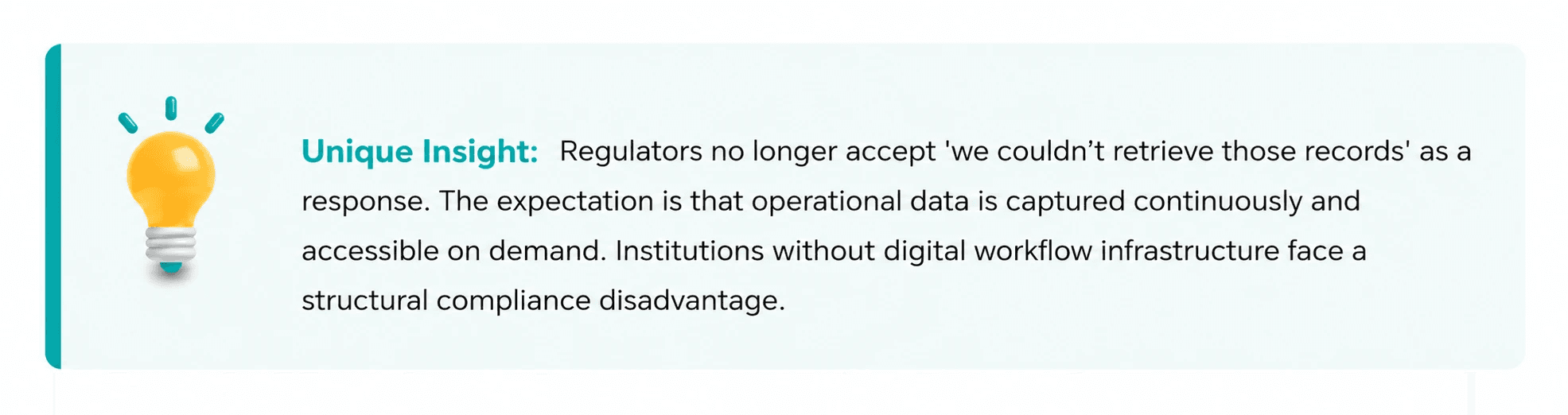
Accessibility — records must be retrievable quickly, in structured formats, during an audit window.
Manual workflows fail all four criteria. Email threads get deleted. WhatsApp logs are fragmented across devices. Spreadsheets lack version control. And even when records exist, assembling them into a coherent audit response is a resource-intensive process that creates significant operational risk.
The Hidden Cost of Audit Unreadiness
The financial consequences of audit failures extend well beyond regulatory fines. The true cost is multi-layered:
1. Remediation & Rework
When auditors identify gaps, institutions must invest significant resources in retroactive documentation, process redesign, and re-training — all under regulatory scrutiny. This diverts operations and compliance teams from strategic work for weeks or months.
2. Opportunity Cost
Loan approvals stalled pending compliance review, customer onboarding delayed by manual KYC re-checks, and operational slowdowns during audit preparation all translate directly into lost revenue and customer attrition.
3. Reputational Exposure
In an environment where customer trust is the primary competitive differentiator for financial institutions [3], any public association with compliance failure carries brand damage that is difficult to quantify and slow to recover.
4. Compounding Risk
Audit findings rarely come in isolation. One gap identified during a review typically triggers a broader investigation. Institutions without robust audit trail infrastructure face the risk of a single finding escalating into systemic compliance scrutiny.
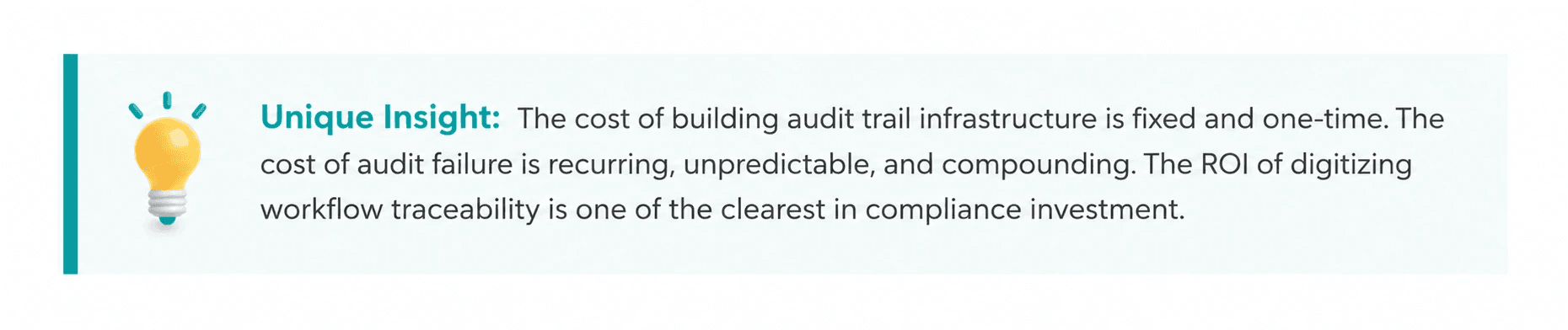
Manual Operations vs. Digital Workflows: A Compliance Comparison
How FlowStax Closes the Compliance Gap
FlowStax is built around a simple premise: every operational action should generate a record automatically, without relying on human discipline to document it correctly.
Across the workflows FlowStax manages — KYC, loan origination, branch-to-central communications, inventory, and claims processing — the platform captures and logs the following in real time:
Every form submission, document upload, and data entry event — timestamped and user-attributed.
Every approval, escalation, and decision point — with a full identity record of who acted and under what authorization.
Every SLA breach and auto-escalation trigger — creating a proactive compliance signal before issues become findings.
Every communication thread — consolidating WhatsApp, email, and manual logs into a single auditable stream.
The result is what FlowStax calls a Unified Stream — a single source of truth for every operational workflow, accessible from a real-time dashboard and exportable for regulatory review on demand.
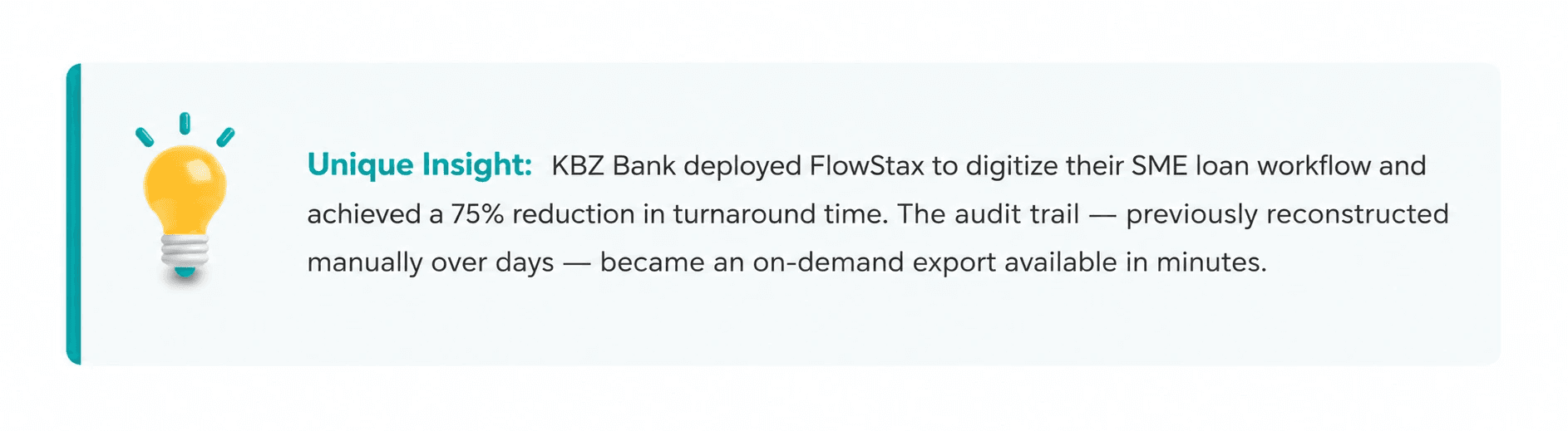
Building Compliance Into Operations By Design
The traditional compliance approach treats audit readiness as a periodic project — something that happens before a review, rather than something built into daily operations. This reactive model is increasingly unsustainable.
Leading financial institutions are shifting to a posture of continuous compliance: where every operational workflow is inherently audit-ready, and compliance evidence is generated as a natural byproduct of doing the work. FlowStax enables this shift through three design principles:
1. Default Capture
Audit trail generation is not an opt-in feature. In FlowStax, every workflow action is logged automatically — there is no configuration required to enable compliance recording.
2. Immutable Records
Once captured, workflow records cannot be modified or deleted. This tamper-proof architecture ensures that the audit trail remains credible and defensible under regulatory scrutiny.
3. Structured Exportability
Audit data in FlowStax is stored in structured, standardized formats that can be exported and presented directly to regulators — eliminating the manual assembly work that consumes compliance teams during review cycles.
The Broader Regulatory Trend: Why This Is Urgent Now
Regulatory momentum across Southeast Asia is accelerating. Central banks and financial regulatory authorities in markets including Myanmar, Thailand, Vietnam, and Singapore have all issued updated guidance on digital operational resilience and record-keeping requirements [4] in the past 18 months.
Globally, the Basel Committee on Banking Supervision continues to strengthen expectations around internal controls and operational risk governance [5]. Institutions that delay building audit trail infrastructure are not managing risk — they are accumulating it.
Frequently Asked Questions (FAQ)
Q: What is a digital audit trail and why does it matter for financial institutions?
A digital audit trail is an automated, chronological log of every action taken within an operational workflow — who initiated it, who approved it, when, and what data was involved. For financial institutions, regulators such as the MAS, CBUAE, and central banks across Southeast Asia increasingly require this traceability as evidence of internal control compliance. Without it, organizations risk fines, license suspensions, and reputational damage.
Q: How does FlowStax generate audit trails automatically?
FlowStax captures every interaction within a workflow — form submissions, approvals, escalations, document uploads, and status changes — and logs them in real time on a secure, centralized platform. This data is timestamped, user-attributed, and exportable for regulatory review, eliminating the need to manually reconstruct records during an audit.
Q: Can FlowStax replace our existing core banking system?
No. FlowStax is an operational orchestration layer that sits alongside your existing core banking or ERP systems. It digitizes and automates the workflows around those systems — onboarding, loan processing, KYC, escalations — without disrupting the underlying infrastructure.
Q: How quickly can FlowStax be deployed for compliance use cases?
FlowStax's no-code drag-and-drop workflow builder allows business teams (not just IT) to configure and deploy workflows rapidly. Most compliance-critical workflows — such as KYC, document approval chains, and SLA tracking — can be live within days, not months.
Q: What industries benefit most from FlowStax's compliance capabilities?
Banking and financial services are the primary beneficiaries, particularly institutions running branch networks, SME lending, insurance claims, or multi-party KYC processes. Any industry with regulatory audit requirements and high operational complexity — healthcare, logistics, government services — can equally leverage FlowStax's digital audit trail capabilities.
References
[1] Basel Committee on Banking Supervision — Principles for Operational Resilience, 2023 update. bis.org/bcbs/publ.
https://www.bis.org/bcbs/publ/d516.htm
[2] Monetary Authority of Singapore — Guidelines on Risk Management Practices, Technology Risk, 2024. mas.gov.sg
https://www.mas.gov.sg/regulation/guidelines/technology-risk-management-guidelines
[3] Edelman Trust Barometer — Financial Services Sector Report, 2024. edelman.com/trust
https://www.edelman.com/trust/2024/trust-barometer
[4] ASEAN Financial Innovation Network (AFIN) — Digital Operations Compliance Framework, 2024. afin.network
https://www.mas.gov.sg/news/media-releases/2017/asean-financial-innovation-network-to-support-financial-services-innovation-and-inclusion
[5] BIS Working Papers on Operational Risk and Data Governance, 2025. bis.org/publ
https://www.bis.org/wpapers/index.htm