



Most AI Projects Fail. Here’s Exactly Why?
Despite record investment in AI tooling, most enterprise AI initiatives stall, underperform, or quietly vanish. The failure is rarely technical. It is organisational, hiding in approval chains, data pipelines, and accountability gaps that no LLM can fix on its own.
A team deploys an AI tool. It works. The output is fast, accurate, and structured. Six months later, usage metrics are healthy, and nothing has changed. The workflows run at exactly the same speed they always did, the same people are making the same decisions, and somewhere in the building, someone is copy-pasting AI-generated formatting into a report they wrote entirely by hand.
This is not a technology failure. It is a far more stubborn kind of failure, one that survives good tooling, adequate budgets, and genuine executive commitment. To fix it, you have to understand exactly where it lives.
The real failure modes
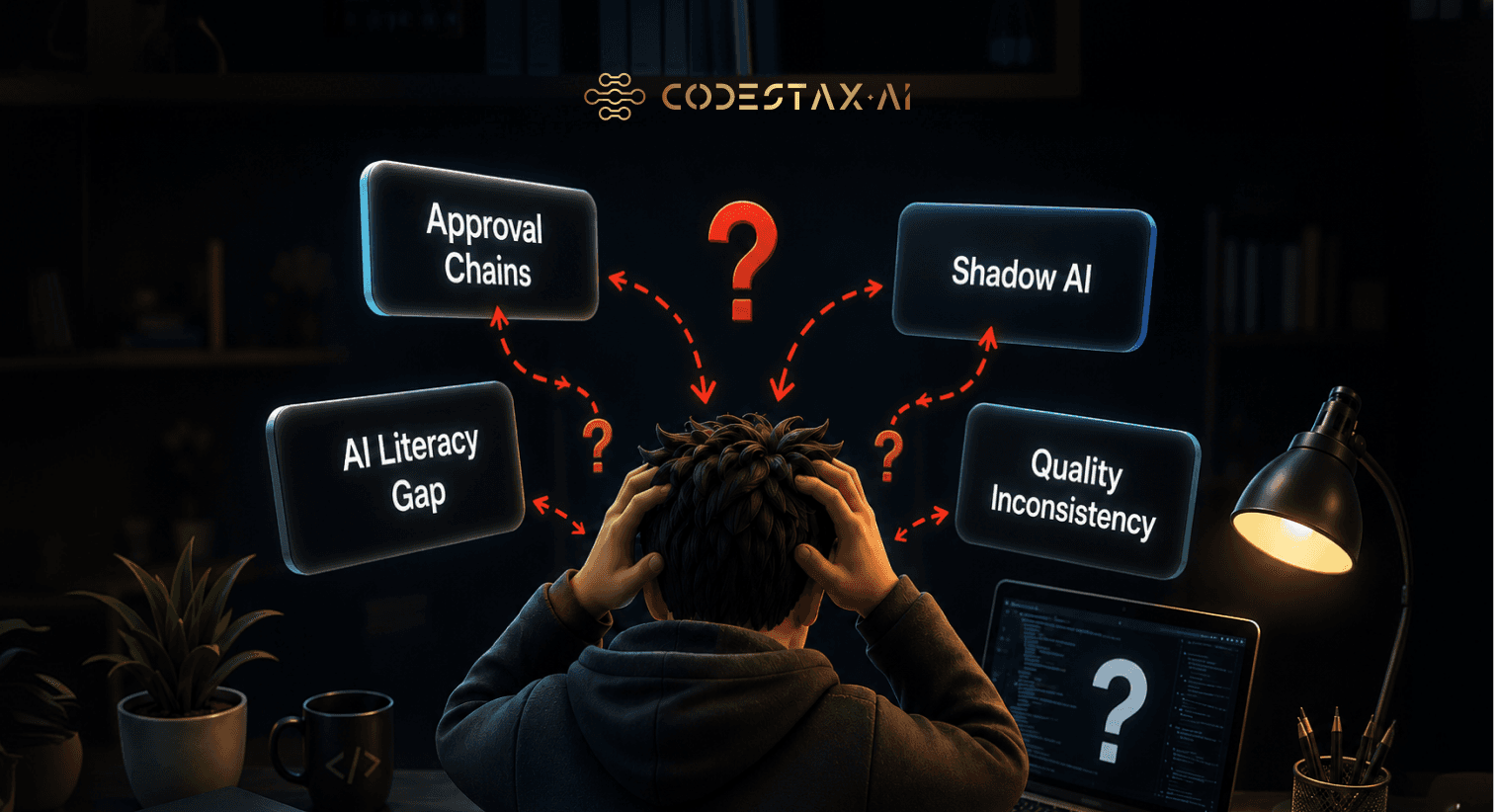
The approval chain that AI never escapes
AI output enters the same review queue that existed before the tool arrived. The queue moves at human speed. Fast AI feeding a slow approval chain produces one outcome: the illusion of modernisation with none of the velocity.
Accountability vacuum at the output level
Nobody has explicitly decided who is authorised to act on AI output, and under what conditions. In the absence of that decision, every person in the chain defaults to universal human review. Not because they distrust the model, but because they cannot afford to be the one who trusted it and was wrong.
Shadow AI and the data sovereignty gap
When AI tools are slow to arrive officially, employees use public consumer-grade LLMs instead. Every confidential BRD, strategy document, or client brief pasted into a public prompt is a potential data leak, and a compliance liability that most security teams cannot even audit.
The AI literacy gap
Effective use of LLMs requires prompt engineering skill that most employees simply do not have. When outputs are inconsistent or confusing, people stop trusting the tool and revert to old workflows, often invisibly, while adoption metrics report healthy usage.
Pilot purgatory
Pilots work in controlled conditions, clean data, motivated team, sympathetic evaluation. Production exposes integration complexity, edge cases, and organisational friction the pilot never encountered. Without deliberate planning for scale, most pilots stay pilots.
Quality inconsistency across the organisation
When different employees use different prompts for the same task, output quality varies wildly. There is no standard voice, no standard structure, no reliable baseline. The AI works, just differently for every person who uses it.
Two real examples, and what they reveal
These are not hypothetical. They are patterns visible in organisations that deployed AI in good faith and still ended up with theatre instead of transformation.
📋 Case: Compliance AI that nobody used
A procurement team deployed an AI that could ingest SOC 2 reports, security questionnaires, and certification documents, hundreds of pages per vendor, and produce a structured risk summary with flagged controls in minutes.
The Director of Procurement instituted a “trust but verify” mandate: the AI could generate the summary, but a human analyst still had to read every source document in full before the ticket was accepted.
The analysts quickly stopped reading the AI summary at all. They spent days on the PDFs as they always had, then copy-pasted the AI’s formatting into their report so the adoption metrics looked healthy. The tool worked. The accountability vacuum above it meant nobody was authorised to trust it, so nobody did.
✅ Case: The QA tool that doubled the workload
A QA team deployed an AI that generated test cases from requirements specs, catching edge cases humans missed, producing structured outputs in minutes rather than days.
The test manager added a comparison step: before any AI-generated test cases could proceed, a senior QAE had to independently write their own cases from the same spec, then compare them against the AI’s output and document all gaps.
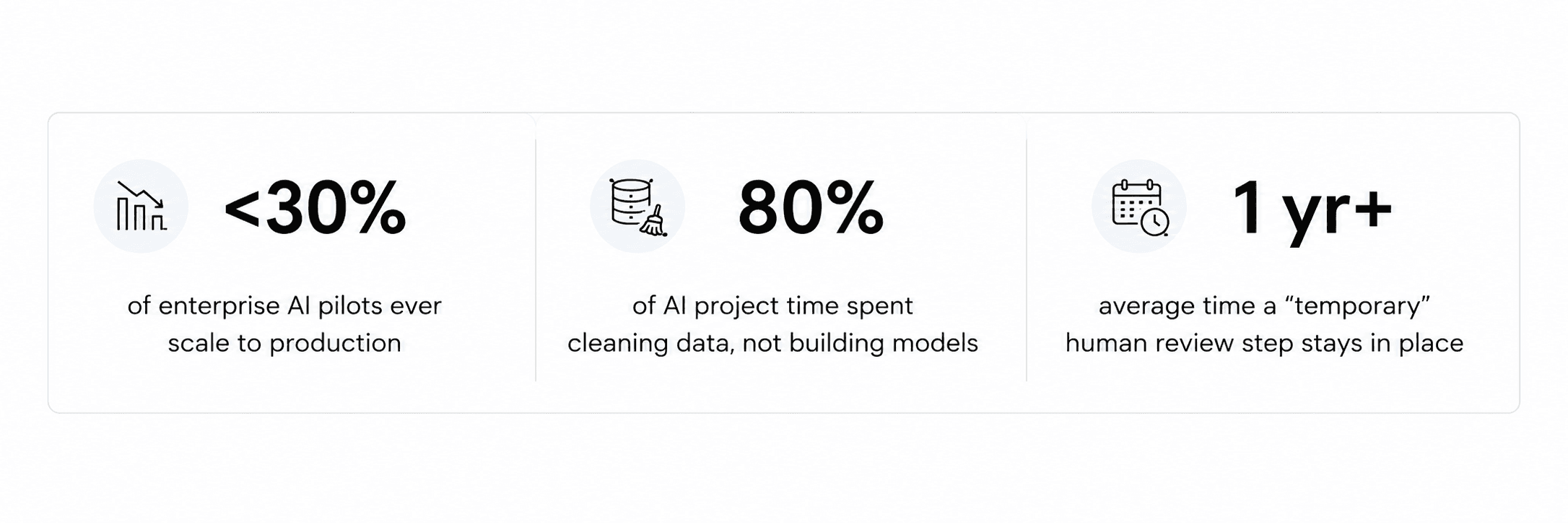
The senior QAEs were now doing their original job in full, plus a comparison exercise on top. The “temporary” review step was introduced over a year ago. It is still there. The bottleneck didn’t move, it just acquired a second input.
“Every decision in the approval chain was locally rational. The cumulative effect was an organisation that looks modernised on the surface and runs on the same human bottlenecks underneath.”
This is the core diagnosis: AI theatre is not caused by bad technology. It is powered by an accountability vacuum. The human approval chain that fills that vacuum is what keeps the theatre running, and the chain always wins.
What actually fixing it looks like
The organisations that move past AI theatre share a common discipline. Before the tool goes live, they make the accountability question explicit: who is authorised to act on this output, under what conditions, and who owns the outcome when it is wrong?
That shifts the human role from universal reviewer to exception handler. For routine vendor assessments, the AI summary is the accepted input and human reviews only flagged exceptions. For standard feature specs, AI-generated test cases go directly to the team, and the senior QAE reviews only high-complexity scenarios. Experienced people do more of what they are actually good at. The review chain collapses because the need to self-protect through process disappears.
Alongside accountability clarity, two other structural requirements consistently determine whether AI deployment succeeds or stalls.
Data sovereignty from day one
When enterprise AI lacks a secure, auditable perimeter, employees route around it using consumer tools. Every confidential document that leaves the corporate boundary via a public prompt is both a compliance failure and a governance gap that cannot be retrospectively closed.
Standardised, template-driven workflows
Prompt engineering skill should not determine output quality. When AI workflows are embedded in purpose-built templates with defined inputs and structured outputs, quality becomes consistent, and employees who are not AI-literate get the same results as those who are.
How Launchpad addresses the root causes
Launchpad was built from exactly this diagnosis. It is not a general-purpose AI interface. It is a managed cognitive gateway designed to eliminate the specific failure modes that keep AI projects in theatre mode.
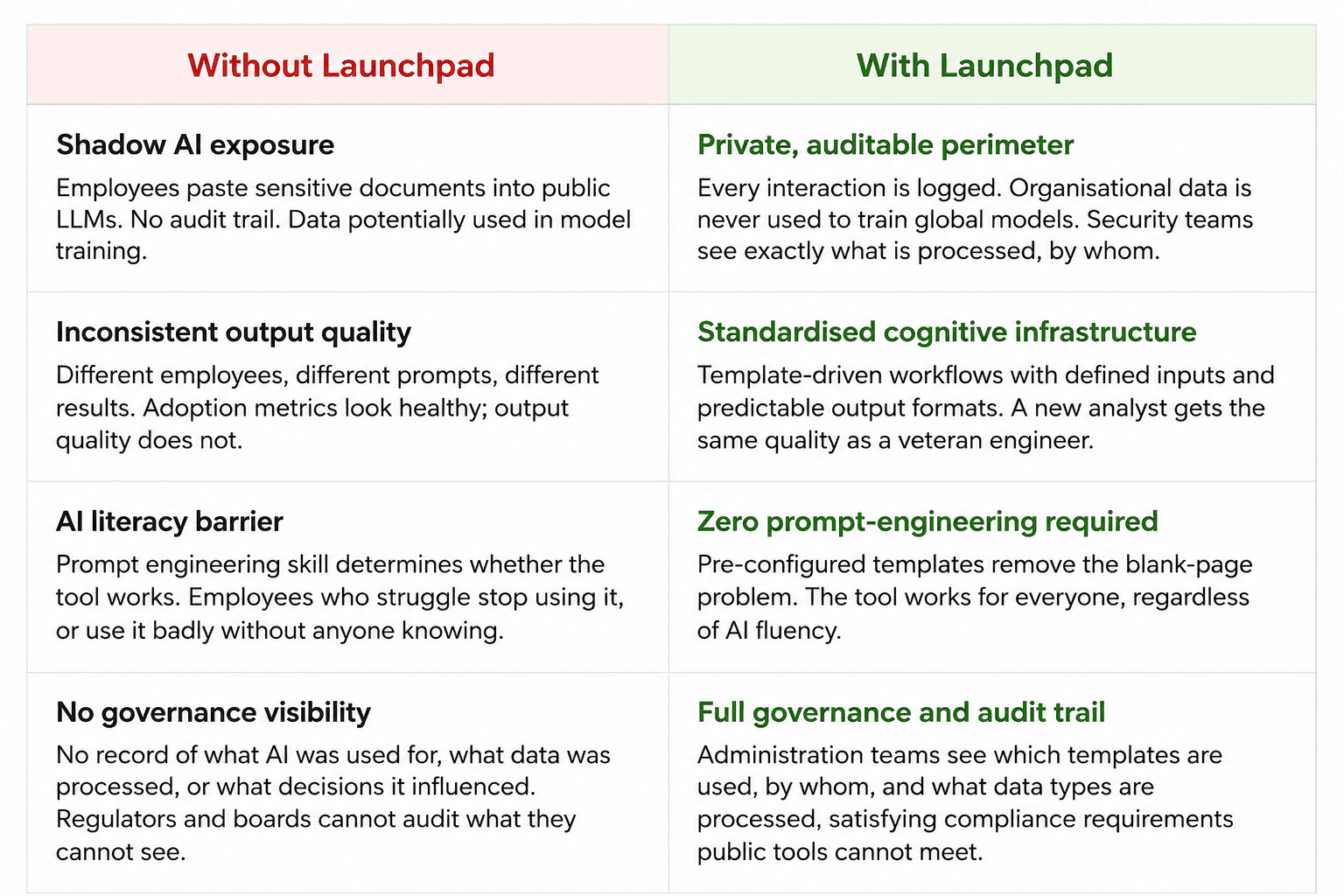
Critically, Launchpad is built as an assisted AI tool, not a replacement. It handles the heavy lifting of data transformation (turning a complex BRD into structured test cases, or a 200-page compliance submission into a risk summary) so that the human professional focuses on the judgment, exception handling, and decision-making that AI cannot do. The human stays in the loop at every critical point. The accountability structure that organisations need is not circumvented, it is made manageable.
The question every deployment should start with
Before the next AI initiative, skip the technical readiness checklist for a day. Run a decision-authority audit instead. For every output the tool will produce, ask: who currently has to approve it, why do they have to approve it, and what conditions would allow that approval step to not exist?
If that third column stays empty, if nobody can articulate what would allow the AI output to flow through without a human redoing the work, the tool will work and nothing will change. There will be a faster system feeding into the same slow chain, and six months later someone will be copy-pasting its formatting into a report they wrote by hand.
AI theatre does not end when better tools arrive. It ends when the accountability question is answered before the tool is deployed, and when the infrastructure around the tool is built to make that accountability real, auditable, and safe.
That is precisely what Launchpad is designed to do.