


From Blockchain Foundations to Web3 Architecture: How Decentralized Apps Work Behind the Scenes
What is Blockchain?
Blockchain is a peer-to-peer decentralized distributed ledger technology that makes records of any digital asset transparent, secure, and immutable, without needing any centralized authority or third-party intermediary.
It is revolutionizing industries by enabling trustless systems, reducing fraud, and improving transparency. Nearly 90% of U.S. and European financial institutions are already exploring blockchain for business transformation.
A blockchain network is:
Decentralized — No single authority controls it
Distributed — Data is shared across multiple nodes
Peer-to-Peer — Participants interact without intermediaries
These features eliminate single points of failure and make the system resilient, scalable, and secure.
What is Blockchain Technology?
Blockchain technology is a decentralized digital ledger that records transactions across several computers in a way that ensures:
✔️ Security
✔️ Transparency
✔️ Immutability
Each set of verified transactions forms a block, and every block is cryptographically linked to the previous one — creating a chain of blocks.
Blockchain supports cryptocurrencies like Bitcoin and powers smart contracts, DeFi, NFTs, identity management, and secure data sharing applications.
How Does Blockchain Technology Work?
Blockchain can be viewed as a shared ledger that anyone on the network can validate but no one can alter. Every participant has a copy of the ledger, and consensus ensures trust without central control.
Transaction Flow
To interact with blockchain, users need a wallet secured by cryptographic keys. This wallet authorizes and signs transactions.
Benefits of Blockchain Technology
Types of Blockchain
Are Bitcoin and Blockchain the Same?
No.
Bitcoin is a digital cryptocurrency, whereas blockchain is the technology behind it.
Relationship Between Bitcoin and Blockchain
Decentralization: Bitcoin transactions are processed by a distributed network of miners, not a bank.
Miners: Miners validate and record transactions by solving cryptographic puzzles. Once verified, transactions are added to blocks.
Blockchain Formation: Each validated block links to the previous block, forming an immutable blockchain.
Simplified Concept
Blockchain: A chain of blocks storing verified data
Bitcoin: A cryptocurrency operating on that blockchain
How Bitcoin Uses Blockchain
A transaction is initiated
Miners validate the transaction puzzle
Validated transactions form a block
Block links to previous block
Ledger updates across all nodes
Bitcoin runs on blockchain, but blockchain can exist without Bitcoin.
Understanding the Web Evolution: Web1 → Web2 → Web3
The internet has evolved over decades — not just in appearance, but in how we use and control data.
Web1: The Static Web (1990–2005)
Read-only websites
No interaction
Websites acted like digital newspapers (Yahoo, early Google)
Web2: The Social Web (2005–Present)
Users create content
Companies own your data
Centralized platforms: Facebook, YouTube, Instagram
Problem?
➡️ Users generate data, but corporations control and monetize it.
Web3: The Ownership Web (Future/Now)
Powered by blockchain, Web3 enables:
✔️ Users to own digital identity
✔️ Assets represented as tokens (NFTs, crypto)
✔️ No centralized control
✔️ Transparent and secure interactions
Now Let’s Enter Web3
Blockchain was the foundation.
Web3 is the next evolution built on that foundation.
Web3 brings decentralization to applications, giving users control over identity, assets, and data — without relying on companies.
Web3 Stack Overview
🧱 Layers of Web3 Architecture
1️⃣ Frontend Layer
Built using React, Next.js, or Flutter — similar to Web2.
Difference: Instead of REST APIs, it interacts with smart contracts.
2️⃣ Wallet Layer (MetaMask)
Manages blockchain identity
Signs transactions
Replaces username & password
3️⃣ Web3 Provider Layer
Libraries like ethers.js and web3.js act as a bridge between UI and blockchain.
Bridge UI ↔ Blockchain.
4️⃣ Smart Contract Layer
Blockchain logic written in Solidity.
5️⃣ Blockchain Layer
Stores data, transactions, contracts immutably.
⚡ Mini Web3 DApp Example
Solidity Smart Contract
JavaScript + MetaMask Interaction
Write Data to Blockchain
ABI (Application Binary Interface)
The ABI describes the smart contract’s functions and how to call them.
It acts as a bridge between JavaScript and Solidity, allowing the frontend to interact with the contract.Provider
The provider connects the application to the blockchain network.
It allows the app to read blockchain data and know which network the user is connected to.Signer
The signer represents the user’s wallet (MetaMask).
It signs transactions, proves ownership of the account, and pays gas fees when writing data.Contract Object
The contract object is a JavaScript representation of the deployed smart contract.
Using the contract address, ABI, and signer, the frontend can call smart contract functions like normal JS methods.
In simple terms:
ABI tells how to talk, Provider tells where to talk, Signer tells who is talking, and the Contract is what you are talking to.
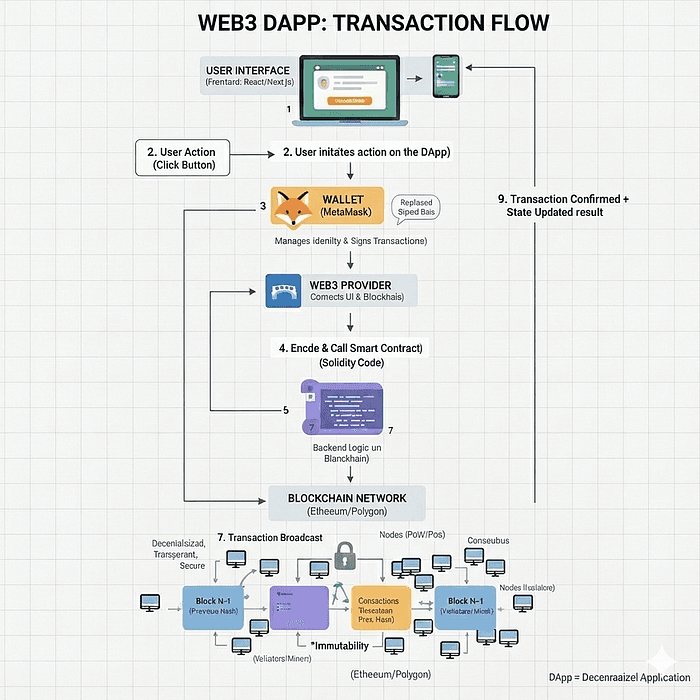
A detailed diagram illustrating the step-by-step transaction flow within a Web3 Decentralized Application (DApp), from the initial user action on the frontend interface through the wallet signature, smart contract execution, and final confirmation on the blockchain network.
Is a Backend Needed in Web3?
In traditional Web2 applications, a backend server handles business logic, authentication, and database operations.
In Web3, this role is fundamentally changed.
For core Web3 applications:
Smart contracts replace backend logic
Blockchain replaces the database(stores data securely)
Wallets (MetaMask) replace username–password authentication
So for many decentralized applications:
✅ No traditional database
✅ No centralized backend server
✅ Blockchain acts as the backend
While some off-chain services may be used for speed or storage, the blockchain remains the core backend and source of truth.
DeFi lending & borrowing
CBDCs (India, China exploring digital currency)
Cross-border payments (Ripple)
🔹 Supply Chain
Walmart & IBM track food traceability
Pharma tracking with MediLedger
🔹 Healthcare
Secure patient data sharing (MedRec)
Clinical trials and drug traceability
🔹 Government
Blockchain-based voting (Voatz)
Land registry (Georgia)
Tax automation (Estonia)
🔹 Other Use Cases
NFTs (Digital ownership)
Digital identity (SelfKey)
IoT network (IOTA)
Conclusion
The journey from Blockchain to Web3 marks a transformational shift in how digital systems are built, owned, and trusted. Blockchain introduced a trustless, immutable, and peer-to-peer foundation that removed the need for central authorities and intermediaries. By distributing data across nodes and securing transactions through cryptography and consensus mechanisms, blockchain solved the long-standing issues of data tampering, single points of failure, and opaque control.
Bitcoin proved the first real-world use case of blockchain, demonstrating how a digital currency could exist without banks. Miners validated transactions, formed blocks, and linked them to create an immutable ledger. This clarified that while Bitcoin is a cryptocurrency, Blockchain is the foundational technology powering it — and much more.
As the internet evolved from Web1 (read-only) to Web2 (read-write), centralized platforms gained control over user data, identity, and value. This centralization created privacy concerns, censorship risks, and data exploitation. Web3 emerged to address these limitations, enabling a read–write–own internet where users control digital assets, identity, and interaction without surrendering trust to corporations.
Web3 applications, or DApps, use:
React/Flutter on the frontend
MetaMask as identity and wallet
ethers.js/web3.js to connect UI with blockchain
Smart contracts in Solidity to encode logic
A Blockchain network to execute and preserve data forever
This architecture replaces traditional servers and databases with decentralized networks, fundamentally changing how software behaves. Instead of trusting a platform, users trust cryptography and code.
Through examples like the MessageBoard smart contract and JavaScript interactions, we saw that Web3 is not difficult — it is familiar territory for developers who understand JavaScript. The major shift is not in coding skills but in mindset: moving from centralized control to decentralized ownership.
Final Thoughts
Blockchain is not just a technology it is a paradigm shift.
Web1 gave us information
Web2 gave us interaction
Web3 gives us ownership
Web3 empowers users, decentralizes trust, protects privacy, and enables digital economies without borders. Whether it’s finance, healthcare, governance, supply chain, or identity management — blockchain ensures a transparent, secure, and resilient infrastructure.
We are not just using the internet anymore.
We are participating in it.
The future will be built by those who understand blockchain and Web3 — and this article has taken you from the foundations to the architecture that powers decentralized applications.
In a world moving toward digital autonomy, Web3 is not the next version of the internet — it is the next evolution of society.